 Wall Muse
Art for a wall the sun gets to
Most advice about art on a Frame is written for the evening, when the room is dim and the panel is the brightest thing in it. That is the easy hour. The hard hour is two in the afternoon with the blinds up, and it is the hour your wall spends most of its life in.
What a glare free screen costs
Samsung has been pushing the Frame's daylight behaviour hard. Describing the 2026 lineup, its newsroom says the Frame Pro pairs "Pantone Validated ArtfulColor and Glare Free technology" to deliver "rich contrast, lifelike, paper-like color expression and clearer detail, even in bright rooms".
The matte finish genuinely works, and it works by scattering reflected light instead of bouncing it straight back at you. That is why you stop seeing the window in the picture. The light has not gone anywhere, though. It has been spread into a faint, even wash sitting on the surface of whatever is showing.
On a bright picture you will never notice. On a dark one you will. That wash lands on the blacks and lifts them, so the deepest part of the painting goes from black to charcoal, and the depth it was relying on goes with it. Meanwhile the brightness sensor has read a room full of daylight and pushed the panel near the top of its range, which holds the highlights and squeezes the shadows further. By the middle of the day your Frame is a picture with a strong light end and a soft dark one.
That is not a fault to fix. It is a fact to hang around.
Pictures that live in the light
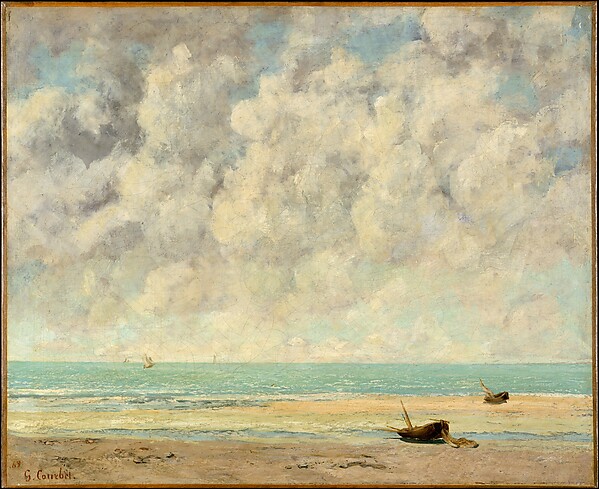
The Courbet above is the whole argument in one canvas. Cloud takes two thirds of it, the sea is a pale green band, and the darkest thing in the picture is a boat the size of your thumb. Nothing in it depends on a black that the room can wash out. Put it on a sunlit wall at noon and it looks like a window onto a better day.
The pictures that do this well have something in common: their structure sits in the top half of the tonal range, so daylight flattering the highlights is flattering the subject.
- Open country and big weather. Horizon low, sky doing the work. Big sky is built from exactly this: badlands, salt marsh, cypress bent by wind, all of it under a lot of air.
- Snow and cold light. A snowfield is a picture that is already mostly white, which makes it immune to the one thing daylight does badly. Winter light is full of them, and it is about to be the right wall for half the world.
- Flat colour and clean line. Woodblock prints read by shape and edge rather than by shadow, so a little surface wash takes nothing from them. Japanese woodblocks are the most daylight proof thing in the vaults.
- Watercolour and anything with paper in its bones. Pale ground, pigment sitting lightly on it. The Frame's matte surface is closer to paper than to glass, and these are the pieces where you can see that.
The other half of the rule is what to save. Nocturnes, lantern light, dark interiors and deep space are wasted at noon and magnificent after dinner. Night pieces and The deep field are evening walls, and hanging them by day is the single most common way to be disappointed by a Frame.
Two settings and one wall
There is a setting most people have never opened. Under Art Mode Options, as Samsung's own walkthrough describes it, Art Effect is on by default and "displays content as close as possible to the original artwork"; turn it off and the TV shows art through your customised picture settings instead. Leave it on. It is the nearest thing the Frame has to a gallery's rule about not improving the lighting.
After that, two dials earn their keep in daylight. Colour Tone goes a step cooler by day and a step warmer after dark, because the room does the same thing. Brightness is an offset on the sensor, not a substitute for it, and in a bright room you rarely need it at all.
Then look at where the sun actually falls. A wall that takes direct afternoon light for an hour is a different wall during that hour, and a wide pale mat helps more than any setting will, for the reasons we went into in what a mat does to a picture.
This week
Wait for the brightest hour your wall gets. Hang a nocturne, look at it properly for a minute, then put something from Big sky in its place and look again. The difference takes two minutes to see and you will not unsee it. After that you have a daytime wall and an evening wall, and the question stops being which picture is best and becomes which picture is best now.