 Wall Muse
What a mat does to a picture on the Frame
The plainest thing in a gallery is the band of card around the picture, and it does more work than the frame does. Your Frame can draw one, it costs nothing, and most walls are running whatever the TV picked on the first day. Four button presses will let you decide for yourself.
What the border is doing
Two things, and both of them are about your eye rather than the art.
The first is separation. A picture that runs to the edge of the bezel reads as a screen that has been filled. The same picture set inside a band of quiet colour reads as an object that was hung. Framers have known this for centuries, which is why almost every work on paper in a public collection sits behind a window of card.
The second is arithmetic. Very little in the vaults is the shape of a television. A panel that is 16 by 9 and a painting that is two thirds as wide as it is tall cannot both be right, so something gives: either the painting is cropped, or there is leftover panel beside it. A mat turns that leftover into a decision. The picture keeps its true proportions and the space around it looks intended, because it now is.
The TV calls it a matte, a framer calls it a mat or a mount, and they mean the same band. On the Frame you reach it from the picture itself: as Samsung's own support page puts it, navigate to the work of art you want to display, press Up on the remote, and select Matte, then a style and a colour.
Pictures that want one
- Anything on paper. Prints, etchings, drawings and woodblocks spent their whole lives behind a mat. A band around a piece from Japanese woodblocks gives the flat colour somewhere to stop, and the line work looks crisper for it.
- Portraits. A face at full bleed across eighty-five inches is a confrontation. The same face inside a border is a portrait. The sitters in Portraits of nobody famous all improve with a little air around them.
- Black and white photography. A light grey band is the traditional answer and still the correct one.
- Pictures with restless edges, where the composition runs off the side rather than resolving. The mat gives it somewhere to land.
Pictures a mat spoils
Modern photographs are the clearest case. They were composed to the edge of the sensor, they arrive at the exact shape of the panel, and a border around one is a border around nothing. Everything in Big sky wants the full four thousand pixels and no card.
Wide landscapes are the second case. A mat takes height from a picture that was already short and wide, and a harbour reduced to a letterbox slot stops being a view.
Then there is dark art, and this one is worth being firm about. A real mat reflects the light in the room. A mat on a Frame makes its own light, because it is the panel doing the work. Put a cream band around a nocturne and you have hung a small lamp around a dark painting: the border becomes the brightest thing on the wall and the picture retreats behind it. Nothing from Night pieces or The deep field should get a mat after sunset. If you want one in daylight, choose the darkest colour on offer.
Choosing the colour
Cream beats pure white in most rooms. Domestic walls are warm, lamplight is warmer still, and a pure white band under a lamp looks blue and slightly cold next to everything around it. Cream sits down quietly and lets the paint be the brightest thing.
Grey is for photographs, and the darker grey is usually better than you expect. Colour is for people matching something specific in the room, a chair or a rug or the spine of a book on the shelf below, and it is a bolder move than it looks: a coloured mat is a claim about the picture, and the picture has to be able to carry it.
One more thing to keep in mind if you have read what the light sensor does after dark: the mat dims along with the picture as the room dims. A band that looked soft at noon can look grey and dead at nine, which is another reason to judge a mat in the evening light you actually live in.
This week
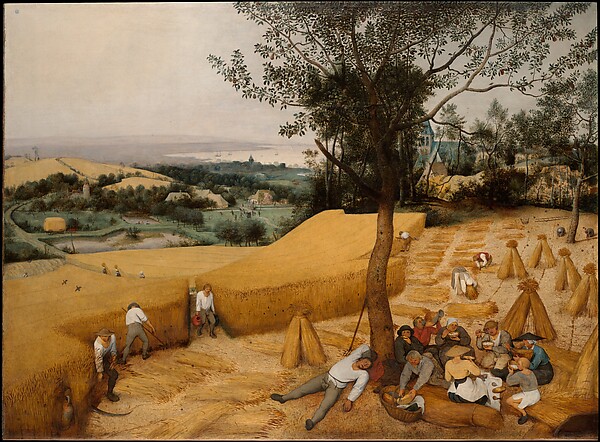
Take one picture and hang it twice. Put the Bruegel above on the wall with a cream mat in the afternoon, then again with no mat at all after dinner, and stand where you normally sit. Ten minutes will settle the question for your room better than any rule here, and once you know which way your room leans you can set the rest of the wall to match. In Wall Muse the choice comes up as you hang a piece: a mat, or none, then it goes to the Frame at full resolution either way.