 Wall Muse
Monet painted the hour, not the place
Monet spent the last thirty years of his life painting the same few subjects over and over: a stack of wheat, a row of poplars, a cathedral front, a pond he dug himself. He was not short of ideas. He had decided that the subject of a picture is not the thing in front of you, it is the light on it at ten past four.
That is a useful idea to borrow if you own a wall that can change its mind.
The centenary is already running
Monet died on 5 December 1926 at Giverny, which makes this the centenary year, and France has been marking it since March. The Normandy programme counts more than a hundred events between March and December across Normandy and the Paris region, closing with a tribute at his grave on the anniversary itself.
The one we would queue for opens this Wednesday. It gathers nearly forty paintings around a single idea, Monet and time, and follows the line from the quick weather of the 1870s, through the series of the 1890s where the same subject is painted at different times of day, to the water lilies at the end. It runs from 30 September to 25 January, which is a long stretch to spend on the other side of the world from it.
The consolation is not a small one. His paintings are in the public domain, the great collections have released their scans, and the pictures cost nothing at all to hang.
Five Monets, four walls
There are five of his pictures in the vaults, and four of them are already scattered through the curated walls.
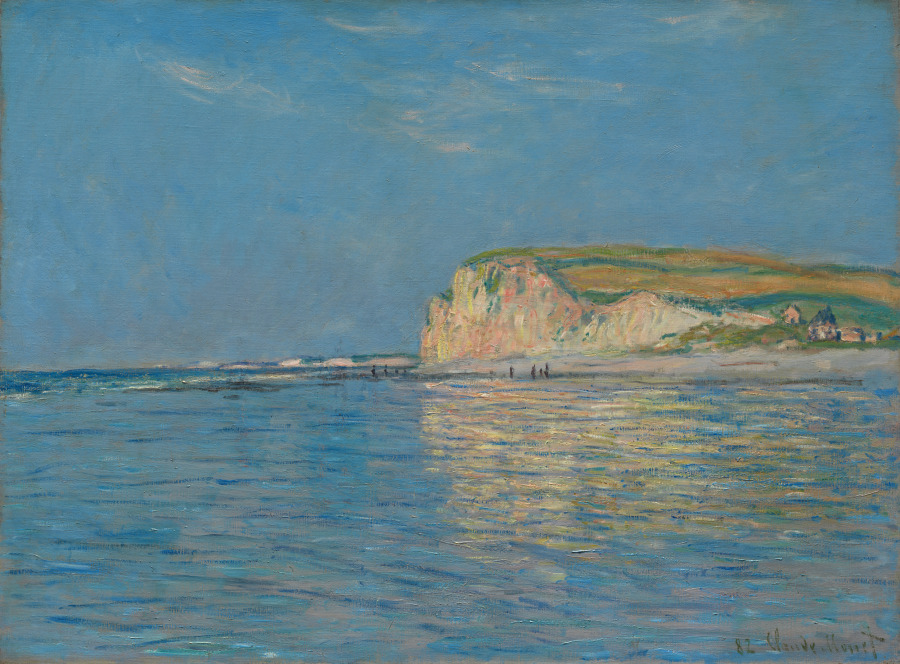
- Low Tide at Pourville, above, in Water, still. A chalk headland taking the low sun, a bay gone almost to nothing, a few people out on the sand. Painted in 1882, and the best argument in the vaults for hanging something with a lot of sky in it.
- Gardener's House at Antibes, 1888, in Golden hour. The Mediterranean seen through pines, painted hot and high, and the piece to put up when the room has gone flat at three in the afternoon.
- Spring Flowers, 1864, in Flowers for the wall. Early work, ten years before anybody used the word Impressionist, and a good deal more solid than what came after it.
- The Red Kerchief, in Winter light. A figure in a red hood passing a glass door with snow behind her, watched from a grey room. It is a tall picture, so it hangs upright on a sideways Frame and between two quiet bands on a normal one.
The fifth is a panel of water lilies from the last years, which sits on the artist page rather than in a wall, and wants a big Frame and a dim room.
Painting the hour at home
Here is the part worth stealing. A Monet series is one view at several hours, hung side by side so you read the difference between them. A Frame can only show one picture at a time, but it can show a different one later, which turns out to be the same trick spread across a day instead of a wall.
So give one wall three pieces rather than one.
- Morning. Something with open sky and cool colour, while the room is bright and the panel is competing with the window. The Pourville beach is exactly this.
- Afternoon. Something warmer and denser, for the hours when the light has gone hard and a pale picture starts to look bleached.
- After dark. Something that was painted dark to begin with. Once the light sensor has turned the panel down, a picture with a lot of white in it looks washed and tired, and a nocturne looks better than it does at noon.
Then let the wall do the changing without you. Wall Muse sets the slideshow on each Frame from the phone, along with brightness and warmth, so the art moves on through the day while you are at work.
This week
Hang three pieces on one Frame and set them rotating. If you want a set that is ready to go, take the beach at Pourville from Water, still for the morning, the Antibes garden from Golden hour for the middle of the day, and anything at all from Night pieces for the evening. Three pictures, one wall, and a room that is not quite the same at each end of the day.