 Wall Muse
The week the light changes fastest
At five past ten on Wednesday morning, Melbourne time, the sun crosses the equator on its way south. That is the equinox, the one moment in the year the whole planet shares, and it is also the week your wall quietly stops looking the way it has looked all season.
Why this week and not another
Two things are true around an equinox, and both of them land on your wall.
The first is that the sun rises due east and sets due west, everywhere on Earth. As EarthSky puts it in its rundown of the September equinox, that holds no matter where you live. For a few days either side, an east window takes the sunrise straight on and a west window takes the sunset the same way, which is why rooms that have been softly lit for months suddenly have a hard bar of light across the floor at breakfast.
The second is speed. Daylight changes length faster around the equinoxes than at any other time of year. Near a solstice the sun barely shifts from one day to the next. Now it is moving by minutes a day, and the difference adds up inside a fortnight. The room you sit in at seven this evening is not the room you sat in three weeks ago.
All of which means the picture you hung in the depth of the season is now hanging in light it was never chosen for. Nothing has gone wrong. The wall has simply moved out from under it. If you have read what the light sensor does after dark, this is the daytime half of the same story: the Frame follows the room, and this week the room is going somewhere.
South of the equator, a wall for the spring
Here in Melbourne the light is coming back, and it comes back cold and very clear before it comes back warm. That is the argument against hanging anything golden right now. A sunset painting in September down here looks like a memory of April.
What suits the returning light is high, clean colour on a pale ground. Flowers for the wall is the obvious wall and it earns it: four centuries of people who could not stop painting bouquets, and the flat brightness of a spring morning is exactly the light those pictures were painted in. A Bosschaert in a glass, a Redon in a plain vase, and the room reads as though something has started.
Water, still is the quieter option and the better one for a room that gets the full afternoon. Harbours at rest and rivers with nowhere to be hold their nerve under strong light in a way that a dark interior cannot.
North of it, a wall for the autumn
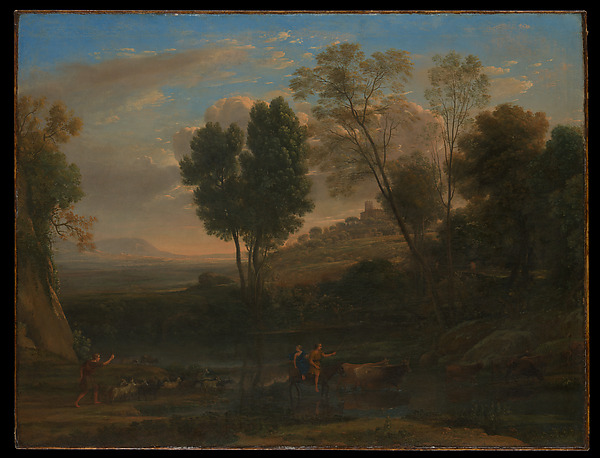
The northern half of the year is doing the reverse, and it has the easier job, because autumn light is flattering and everybody knows it. Golden hour is built for exactly these weeks: twilight over wilderness, a pink cloud, a village catching the sun on its way out. The Claude Lorrain above is the same idea three hundred years earlier, a low sun doing all the work and the rest of the picture agreeing to be quiet about it.
Then, as the evenings close in, Quiet interiors: sunlight across a floor, a letter being read, a room with the door left open. Pictures of being indoors, for the season that sends you indoors. Winter light is waiting after that, and there is no hurry.
The honest version of the advice
None of this is a rule, and we would rather not pretend it is. Seasonal hanging is not about matching a picture to a month on a calendar. It is about noticing that the light in one particular room has changed, and letting the wall answer. A north-facing lounge in Hobart and a north-facing lounge in Edinburgh are different rooms with the same compass reading, and only one of you can see what is actually happening on your own wall.
The useful habit is small: look at the wall at the hour you actually sit in front of it, not at noon when you happen to be walking past.
This week
Pick the hour you are most often in the room, sit down in your usual spot, and look at what is hanging there. If the picture has gone flat, or gone shouty, swap it for one piece from the wall that matches your half of the planet: Flowers for the wall in the south, Golden hour in the north. Leave it up until the clocks change and see whether it still holds. That is the whole ritual, and it takes about two minutes from the phone.
More of the walls are in the masters, and they are free to hang.