 Wall Muse
The hallway picture and the bedroom picture
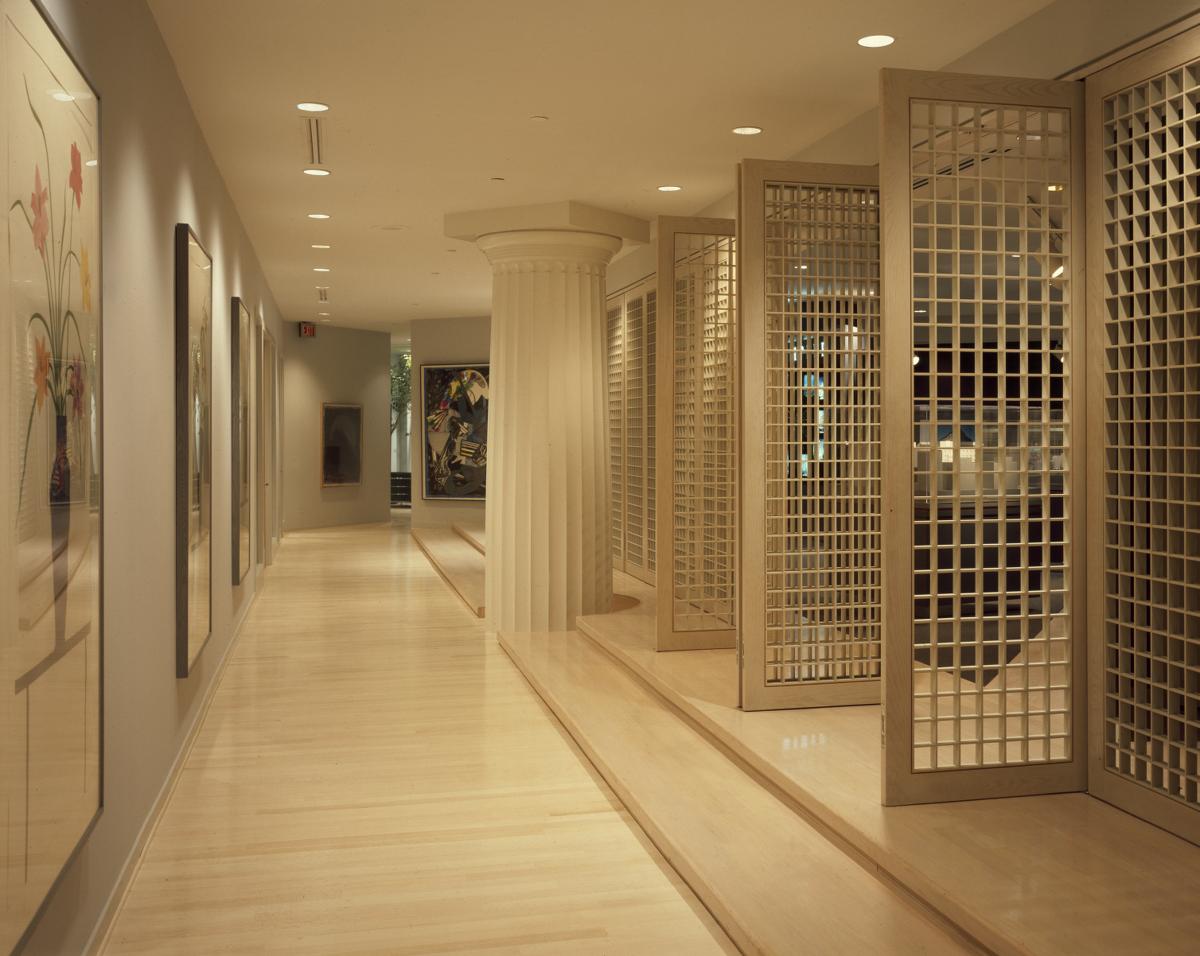
Most advice about what to hang treats a house as one wall. It is not. A picture in a hallway gets two seconds of a sideways glance from an arm's length away. A picture in a bedroom gets a long unfocused look at six in the morning and another at eleven at night. No single painting is good at both, and a Frame is the one place where finding that out costs nothing but a minute.
How long the picture gets
Before the subject, before the colour, ask one thing about the wall: how long does anyone actually look, and from how far away.
A hallway is the shortest look in the house. You are within two metres of the wall, moving, usually seeing the picture on the slant rather than square on, and often in light from a fitting rather than a window. You pass it thirty times a day, so the picture there is seen more often than anything else you own and attended to less.
A bedroom is the opposite in every respect. The look is long, from across the room, lying down, at the two softest hours of the day. Nobody studies a picture in a bedroom. They rest their eyes on it while thinking about something else, which is a real job and a harder one.
Once you have the length of the look, the rest follows.
What holds a hallway
One idea, readable in the time it takes to walk past. A face, a horizon, a single strong shape. A picture that needs you to work out what is going on will never get the chance.
- A person. Nothing stops you in a corridor like someone looking back. Portraits of nobody famous is full of sitters whose names are gone and whose faces are not, and they hold a narrow wall the way a window does.
- Distance. A hallway is a short space, and a picture with miles in it lends the space some of them. Big sky and From the road both open a wall outward.
- Flat colour and clean edges. This is the wall you mostly see from an angle, and pictures that read by shape survive that better than pictures that read by shadow. Japanese woodblocks are the obvious answer.
The hallway is also the one wall in the house where fine detail is worth paying for, because you walk within reach of it. A print whose whole pleasure is the line will be wasted above a sofa three metres back and perfect beside a coat hook.
What to keep out: anything dark. Hallways tend to have no daylight at all, the brightness sensor reads a dim room and dims the panel to match, and a nocturne in a corridor turns into a grey rectangle. We went through why in what the light sensor does to a painting after dark.
What suits a bedroom
Here the rule reverses: nothing that asks a question. No eyes, in particular. A portrait that is good company in a hallway is a different proposition at three in the morning, and the sitter never blinks.
What works is anything with a slow surface and a narrow tonal range. Still water, snow, an empty room with the light crossing it. Water, still and Quiet interiors were made for this wall, Winter light is about to be right for half the world, and after dark Night pieces and The deep field are the only pictures in the vaults that actually improve when the room goes black.
Two settings earn their place in a bedroom and nowhere else.
- The border. Samsung's walkthrough calls it Mount: "Customise the border style and colour to suit your preferences." A wide pale border shrinks the lit area and gives the picture some quiet around it, which matters more in a room you lie down in than anywhere else. The longer argument is in what a mat does to a picture.
- The motion sensor. In a hallway it is the whole point: you walk in, the art is there. In a bedroom it is the thing that lights the wall at two in the morning. The same support page warns that the sensor "may sense motion from a flashing LED, a pet dog, a car moving outside the window", and the setting that governs it, Motion Detector, sits under Sleep Options. A bedroom is the room to turn it down.
Colour tone is worth a nudge warmer here too, for the same reason the lamps in that room are warmer than the ones in the kitchen.
This week
Swap the two pictures over for one evening. Put whatever is hanging in the bedroom into the hallway, and the hallway picture into the bedroom, and leave them for a night and a morning. You will know by breakfast, and you will know it in your body rather than by reasoning about it: one of them will have been pleasant to walk past and tiring to wake up to.
Then put them back the right way round, and give the bedroom something from Water, still. It is free to hang, and it asks nothing of you at all, which in that room is the entire brief.